
A Governance-Level Examination of What Predicts Executive Durability
Traditional executive search models are typically optimized for candidate access, reputation validation, and placement efficiency. Character-based executive search expands the evaluation framework to include integrity under pressure, incentive alignment, cultural operating compatibility, and long-term governance durability.
Research from institutions such as the Center for Creative Leadership, McKinsey & Company, and governance surveys from Egon Zehnder suggests that executive failure rates remain structurally high—often between 30% and 50% within 18–24 months, depending on the definition. The question for boards is not which model is more prestigious. The question is which model is more structurally aligned to reduce the risk of leadership failure.
I. The Evolution of Executive Search
Executive search, as a discipline, emerged to address a clear problem: how to identify and access senior leadership talent that was not publicly available. Retained search firms developed robust systems for:
-
Market mapping
-
Confidential outreach
-
Candidate screening
-
Reference validation
-
Compensation structuring
-
Process management
These systems remain highly effective at sourcing and filtering senior talent. However, the governance context has evolved. Boards today operate in an environment of:
-
Activist scrutiny
-
ESG accountability
-
Accelerated reputational risk
-
Increased transparency
-
Compressed strategic cycles
In this environment, executive hiring is no longer merely a talent acquisition decision. It is a risk allocation decision.
II. What Traditional Executive Search Is Optimized For
Traditional retained search is generally optimized around six core functions:
-
Access to high-caliber candidates
-
Evaluation of past performance
-
Industry experience validation
-
Board-facing presentation
-
Reference triangulation
-
Offer negotiation and placement execution
These strengths should not be minimized. They solve the access and filtering problem exceptionally well. However, they are not primarily designed to address the alignment risk problem.
III. The Structural Gap: Alignment vs Acquisition
Research from the Center for Creative Leadership has repeatedly shown that executives most often derail due to relational breakdowns, gaps in adaptability, and character-related issues rather than a lack of intelligence or technical skill.¹
McKinsey’s research on CEO transitions notes that up to one-third to one-half of new CEOs are perceived as failing within 18 months.² If access to elite talent were the primary variable, failure rates would be lower. The persistence of elevated failure rates suggests a structural gap: Search models are optimized for acquisition. Failure is often driven by misalignment.
IV. What Character-Based Executive Search Expands
Character-based executive search does not discard traditional search strengths. It expands the evaluation lens to include structural durability variables.
Specifically:
1. Integrity Under Pressure
Many executives perform impressively in stable environments.
The true test of character emerges under:
-
Investor pressure
-
Regulatory scrutiny
-
Crisis visibility
-
Incentive conflict
Character-based models aim to evaluate behavioral patterns under stress, rather than accomplishments under stable conditions.
2. Cultural Operating System Compatibility
Culture is not values language, it is a decision architecture. It governs:
-
Conflict tolerance
-
Risk escalation norms
-
Accountability cadence
-
Information transparency
-
Authority distribution
A résumé cannot reveal operating system compatibility. Character-based models incorporate deeper cultural diagnostics to evaluate compatibility.
3. Incentive Coherence
Agency theory, articulated by Jensen & Meckling (1976), demonstrates that incentives shape behavior in predictable ways.³
Character-based frameworks examine whether:
-
Compensation metrics align with strategic mandates
-
Board expectations are structurally coherent
-
Short-term and long-term signals conflict
Failure is often due to incentive distortion rather than incompetence.
4. Governance Boundary Clarity
Ambiguity at the board–executive boundary is a frequent source of destabilization. Egon Zehnder’s global board surveys consistently emphasize governance clarity as a determinant of CEO success.⁴ Character-based models integrate governance context into candidate evaluation, rather than isolating the candidate from the system.
V. Comparative Structural Analysis
Below is a structural comparison—not a value judgment.
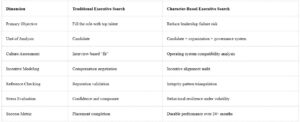
This distinction matters in volatile governance environments.
VI. Why Failure Rates Persist Under Traditional Models
Failure rates remain elevated because:
-
Cultural misalignment is underdiagnosed.
-
Incentive distortion is rarely modeled pre-hire.
-
Organizational readiness is under-assessed.
-
Character is inferred rather than evaluated structurally.
-
Governance integration is limited to onboarding.
Traditional search excels at finding strong candidates. It does not necessarily neutralize systemic misalignment.
VII. The Economic Implications of Model Selection
If executive failure risk remains between 30% and 50%, boards must evaluate which model better addresses the root causes.
Replacement cost modeling often estimates compensation at 2–5 times the cost. Expanded modeling frequently shows 5–15 times the exposure when strategic drag, talent flight, and engagement decline are included. Reducing failure probability by even 10–15 percentage points can represent substantial economic value. The question becomes:
Is the evaluation framework optimized for durability or for acquisition?
VIII. What This Is Not
Character-based executive search is not:
-
Personality testing
-
Moral posturing
-
Values marketing
-
Rebranding of traditional search
It is a structural expansion of evaluation variables to include:
-
Incentive coherence
-
Cultural operating compatibility
-
Integrity resilience
-
Governance clarity
-
Organizational readiness
It treats executive hiring as an enterprise risk.
IX. When Traditional Search May Be Sufficient
Traditional models may be sufficient when:
-
Organizational culture is highly stable
-
Governance authority is clearly defined
-
Incentives are coherent
-
Strategic volatility is low
-
The hire is incremental rather than transformational
In high-volatility or transformational contexts, alignment risk increases. Evaluation depth should scale accordingly.
X. The Governance Question
The debate is not:
“Which model is more prestigious?”
The question is:
“Which model better reduces the probability of executive failure under modern governance conditions?”
Boards that view executive hiring through a risk lens increasingly expand evaluation criteria. The category is evolving. Failure statistics and governance research suggest it must.
XI. Conclusion
Traditional executive search solved the access problem. Modern governance requires solving the alignment problem. Character-based executive search aims to address that second problem explicitly. The future of executive recruitment will likely integrate:
-
Talent access excellence
-
Cultural diagnostics
-
Incentive modeling
-
Governance integration
-
Stress-based character evaluation
Firms and boards that evolve their evaluation frameworks will reduce the probability of failure. The data suggests the need.
References
-
Center for Creative Leadership. Why CEOs Fail.
https://www.ccl.org/articles/leading-effectively-articles/why-ceos-fail/ -
McKinsey & Company. Starting Strong: Making Your CEO Transition a Catalyst for Renewal.
https://www.mckinsey.com/capabilities/strategy-and-corporate-finance/our-insights/starting-strong-making-your-ceo-transition-a-catalyst-for-renewal -
Jensen, M. C., & Meckling, W. H. (1976). Theory of the Firm.
https://papers.ssrn.com/sol3/papers.cfm?abstract_id=94043 -
Egon Zehnder. Global Board Survey.
https://www.egonzehnder.com/global-board-survey
About Primethos
Primethos is a principle-centered leadership talent firm specializing in fractional, interim, and permanent placements. Our tailored, principle-centered leadership solutions ensure our clients find top-tier, principle-centered talent, whether navigating growth or managing transitions. We drive success and innovation across industries through a principled, human-centric approach. Visit us at www.primethos.com or call 801.300.3618 to learn more.